
Thimphu Tshechu Festival Tour – 8 Days Bhutan Cultural Journey
Tour Includes
Tour includes the services of Indruka Tours and Travels's Tour Manager.
Tour Highlights
Request a Callback
We‘ll reach you within minutes
🔒 Your number is never shared with third parties
Itinerary (Day Wise)
Viewing itinerary for 8 days of Paro.
Day 1
Arrive in Paro, Bhutan – Himalayan Mountain Flight, Tachog Lhakhang & Transfer to Thimphu
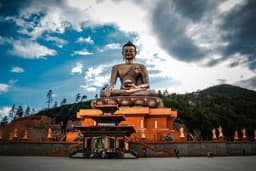
Arrive at Paro International Airport (PBH) on one of the world's most breathtaking mountain approaches, with sweeping aerial views of the Eastern Himalayas – including some of the highest unclimbed peaks on earth – before the aircraft descends into the lush, narrow Paro Valley.As the runway comes into view, the iconic silhouettes of Paro Dzong and Ta Dzong emerge along the Pa Chu River below, offering a dramatic first glimpse of Bhutan's extraordinary architectural heritage.Clear immigration and customs before being warmly welcomed by your Indruka Tours guide, and begin the scenic one-hour drive eastward to Thimphu, Bhutan's capital and one of the world's few capital cities without a single traffic light.En route, stop at the sacred Tachog Lhakhang along the Paro–Thimphu highway – a revered 14th-century temple accessible via a traditional iron chain bridge over the Paro Chhu River, attributed to the legendary Tibetan saint and bridge-builder Thangtong Gyalpo, who constructed dozens of such iron bridges across the Himalayan kingdoms.Arrive in Thimphu and visit the National Memorial Chorten, built in memory of Bhutan's beloved Third King, where devoted locals gather daily to spin prayer wheels and circumambulate in a profoundly moving expression of living Buddhist practice.Stop at the colossal Buddha Dordenma statue at Kuensel Phodrang – 51.5 meters of gilded bronze overlooking the entire Thimphu Valley – before a colorful late-afternoon visit to the Centenary Farmers Market, the best place in Bhutan to encounter the full sensory richness of local produce, dried meats, chillies, and traditional textiles.Check in to your hotel in Thimphu as the valley lights begin to glow. Overnight Thimphu.
Day 2
Thimphu Tshechu Festival – Sacred Mask Dances & Buddhist Ceremonies at Tashichho Dzong
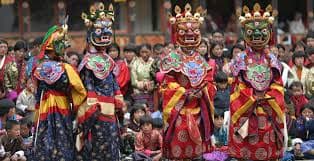
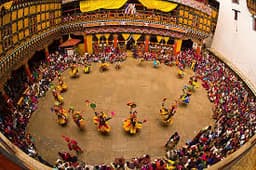
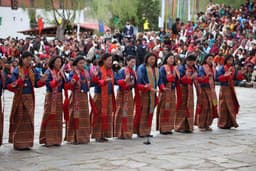
This is the day the entire journey has been building toward: the Thimphu Tshechu – one of the most important and visually spectacular religious festivals in the Himalayan Buddhist world, held annually in the courtyard of Tashichho Dzong.The Tshechu (meaning 'tenth day') is celebrated on the tenth day of the eighth month of the Bhutanese lunar calendar and draws thousands of Bhutanese from across the kingdom, all dressed in their finest traditional Kira and Gho, gathering to receive blessings and witness sacred performances.Watch as elaborately costumed monks and lay performers present the Cham – sacred mask dances rooted in 8th-century Vajrayana Buddhist traditions – each dance a living scripture, dramatizing the triumph of good over evil, the life of Guru Rinpoche, and the protection of the Dharma.The Thimphu Tshechu is one of the few festivals in Bhutan where the Thongdrel – an enormous sacred appliqué thangka – is unfurled before dawn at the final day, believed to confer liberation upon all who behold it.Between dances, explore the magnificent Tashichho Dzong itself: the seat of Bhutan's royal government and central monastic body, with whitewashed walls, golden roofs, and courtyards that hold the weight of the kingdom's unbroken spiritual tradition.The atmosphere of color, devotion, music, and community at the Thimphu Tshechu offers a depth of cultural immersion that remains one of the most memorable experiences in all of Bhutanese travel. Overnight Thimphu.
Day 3
Thimphu to Phobjikha Valley via Dochula Pass – 108 Chortens, Himalayan Views & Gangtey Monastery
Depart Thimphu and ascend steadily to Dochula Pass at 3,050 meters, one of Bhutan's most celebrated high-altitude viewpoints and an unmissable landmark on any Bhutan cultural tour itinerary.On clear days, the pass delivers breathtaking 180-degree panoramas of the Eastern Himalayan range – a sweeping arc of snow-capped peaks including Gangkar Puensum, the world's highest unclimbed mountain, stretching magnificently along the Bhutan–Tibet border.Explore the 108 Druk Wangyal Chortens – memorial stupas commissioned by the Royal Queen Mother to honor soldiers who gave their lives in the 2003 military campaign – set against one of the finest Himalayan skylines in the country.Continue the descent through subtropical valleys and subtropical forest, where the road drops through increasingly dramatic highland terrain before opening into the wide, peaceful expanse of Phobjikha Valley.Arrive in Phobjikha (Gangtey) Valley – a UNESCO-recognized glacial valley and one of Bhutan's most ecologically sensitive conservation zones, protected as the winter habitat of the endangered Black-Necked Crane (Grus nigricollis) migrating annually from the Tibetan Plateau.Visit Gangtey Monastery (Gangtey Gonpa) – a magnificent 17th-century Nyingmapa monastery perched on a forested ridge above the valley floor, founded by Pema Trinley and home to one of the most important Nyingma lineages in Bhutan.Stop at the Black-Necked Crane Information Centre to learn about the remarkable ecology of the valley and the deep cultural reverence Bhutanese people hold for these rare migratory birds. Overnight Phobjikha Valley.
Day 4
Phobjikha Valley Morning Walk & Gangtey Nature Trail – Drive to Punakha via Chimi Lhakhang
Begin the morning with the Gangtey Nature Trail – one of the most rewarding short hikes in central Bhutan – looping through open marshland, ancient pine forest, and traditional farming villages at the heart of the Black-Necked Crane Reserve.The trail offers sweeping views across the full breadth of the glacial valley, with mist often still clinging to the ridgelines at dawn, creating an atmosphere of extraordinary natural calm and remoteness.Depart Phobjikha and drive toward Wangdue Phodrang for a visit to Wangdue Phodrang Dzong, an ancient fortress perched dramatically on a narrow ridge at the confluence of the Puna Tsang Chhu and Dang Chhu rivers – one of Bhutan's most strategically positioned dzongs, commanding the valley below.Continue into the warmer, subtropical Punakha Valley, stopping at Chimi Lhakhang – the beloved Fertility Temple dedicated to the eccentric 15th-century saint Drukpa Kuenley, the 'Divine Madman', reached by a 30-minute walk through golden paddy fields and mustard flower meadows.Learn how Drukpa Kuenley's unconventional methods – humor, song, and radical behavior – became a uniquely Bhutanese expression of enlightened compassion, and why couples from across the region still make pilgrimages here to seek his blessings.Arrive in Punakha Valley by late afternoon, once Bhutan's royal capital and still one of its most historically significant and agriculturally lush regions. Overnight Punakha.
Day 5
Punakha Sightseeing – Khamsum Yulley Namgyal Chorten Hike & Punakha Dzong
Begin the morning with a rewarding hike to Khamsum Yulley Namgyal Chorten, a beautifully crafted four-storey hilltop temple commissioned by Her Majesty the Royal Queen Mother and built over eight years to ensure the peace, prosperity, and spiritual protection of Bhutan.The 45-minute trail through paddy fields and farmland leads to a ridge offering sweeping views of the Mo Chhu River, Punakha Valley's patchwork of rice terraces, and the surrounding forested hills – among the most photographed vantage points in the region.The temple's interior walls are richly adorned with painted deities, mandalas, and Buddhist imagery executed in the finest Bhutanese traditional style, offering a quiet and contemplative counterpoint to the grandeur of Punakha Dzong below.After descending, visit Punakha Dzong – widely regarded as the most beautiful dzong in Bhutan – standing at the confluence of the Pho Chhu (Father River) and Mo Chhu (Mother River), its whitewashed walls and gilded spires rising from the water like a vision from another century.Explore the dzong's richly decorated courtyards, assembly halls, and temples, layered with centuries of Bhutanese royal and religious history – including the site of the first coronation of Bhutan's monarchs and the historic royal wedding of the Fourth Druk Gyalpo.Spend the evening by the riverside in Punakha, one of Bhutan's warmest and most fertile valleys, before a peaceful overnight. Overnight Punakha.
Day 6
Punakha to Paro via Simtokha Dzong – Ta Dzong, Rinpung Dzong & Paro Town
Depart Punakha and drive westward toward Paro, stopping en route at Simtokha Dzong on the outskirts of Thimphu – one of the oldest surviving dzongs in Bhutan, built in 1629 by Zhabdrung Ngawang Namgyal to guard the valley approaches to his newly unified capital.Explore Simtokha Dzong's exquisitely preserved frescoes and carved slate relief panels depicting the life of Guru Rinpoche – among the finest examples of early 17th-century Bhutanese sacred art still displayed in their original architectural setting.Continue to Paro Valley, arriving to the iconic sight of Rinpung Dzong and Ta Dzong framed against a backdrop of pine-covered ridges and the meandering Paro Chhu River below.Visit Ta Dzong – the National Museum of Bhutan – housed in a striking circular watchtower originally built to defend Paro Dzong, its galleries now holding superb collections of ancient thangkas, royal artefacts, natural history specimens, and Bhutanese weapons tracing the kingdom's history across the centuries.Descend to the majestic Rinpung Dzong ('Fortress on a Heap of Jewels'), built in 1646 and still an active monastery and district administrative center, its whitewashed walls, wooden cantilever bridges, and mountain backdrop making it one of the most photographed landmarks in Bhutan.Spend the evening exploring Paro's charming main street, lined with traditional painted wooden shopfronts, local handicraft stalls, cozy cafés, and galleries selling handwoven textiles and ceremonial arts. Overnight Paro.
Day 7
Tiger's Nest Hike – Paro Taktsang Monastery at 3,120m & Afternoon at Leisure in Paro
Begin Bhutan's most iconic trek with an early morning start toward Paro Taktsang – the Tiger's Nest Monastery (Taktsang Palphug) – clinging to a sheer granite cliff at 3,120 meters above the Paro Valley floor in one of the most dramatic settings of any religious site on earth.The ascent winds through fragrant blue pine forest and winding corridors of colorful prayer flags, with each switchback opening increasingly dramatic views of the monastery's gilded rooftops against the vertical rock face – the single most iconic image in Himalayan travel.Rest at the Taktsang Cafeteria viewpoint at the halfway point – one of the finest photography positions in all of Bhutan – before continuing the final ascent to the monastery complex itself, crossing a dramatic suspension bridge above a waterfall-fed gorge.Enter the sacred complex where Guru Rinpoche (Padmasambhava) is said to have flown from Tibet on the back of a tigress in the 8th century and meditated in the mountain caves before establishing Vajrayana Buddhism throughout the Himalayan kingdoms.Explore the interconnected temples, meditation halls, and sacred caves of the Taktsang complex, each resonating with centuries of unbroken devotional practice and offering a profound sense of both physical achievement and spiritual arrival.The full round-trip hike takes approximately 4–5 hours; a horse can be arranged to the halfway cafeteria for those preferring a gentler ascent, making the Tiger's Nest accessible at any fitness level.Return to Paro for a relaxed afternoon of shopping and exploration – browsing handwoven Bhutanese textiles, hand-painted thangkas, wooden prayer bowls, and locally crafted ceremonial items as lasting keepsakes of an extraordinary journey. Overnight Paro.
Day 8
Departure from Paro International Airport – End of Bhutan Tour
Enjoy a final breakfast in Paro, taking a quiet moment to reflect on eight extraordinary days – the sacred dances of the Thimphu Tshechu, the crane-watched stillness of Phobjikha Valley, the riverside grandeur of Punakha Dzong, and the soaring climb to Tiger's Nest that brought the journey to its unforgettable peak.Complete last-minute packing and check out of your hotel, carrying the warmth of Bhutanese hospitality and the quiet wonder of a kingdom that has chosen meaning over speed, and happiness over growth.Transfer to Paro International Airport (PBH) for your onward flight, departing Bhutan with a deep and lasting sense of gratitude for one of the world's most extraordinary cultural travel experiences.
Know, before you book
Please note: Seats are subject to availability at time of booking.
Airline: On group tours we fly with group-friendly airlines.
Economy class by default.
Upgrades to Business / First Class available on request.
Tour Details
Tour Information
Read this to prepare for your tour in the best way!
- Airfare (Economy class) (optional)
- 3-star and above hotel accommodation (twin sharing)
- Daily breakfast ,Lunch & dinners
- English-speaking Tour Manager throughout
- Government Taxes
- Travel insurance (optional)
- Sightseeing Fees & Visa
Need to Know
- Carry comfortable walking shoes — cobblestone streets ahead!
- Currency: Dollar/ Crypto. ATMs are widely available.
- Weather in June: 18 °C – 25 °C. Light jacket recommended.
- Sustainable Development Fee (SDF) of USD100 per night per adult and USD50 for children aged 5 to 12 years old. Children below 5 years are waived.
- A one-time visa application fee of USD40.
- For Indian: Sustainable Development Fee (SDF) of Rs.1200 per night per adult and Rs.600 for children aged 5 to 12 years old. Children below 5 years are waived and Government of Bhutan will provide on arrival visa.
Cancellation Policy
| Days before departure | Cancellation charge |
|---|---|
| 60+ days | 10% of tour cost |
| 30–59 days | 25% of tour cost |
| 15–29 days | 50% of tour cost |
| 0–14 days | 100% of tour cost |